
ASTM vs ISO Transmission Loss Measurements: Why Thailand Follows ASTM Standards and What the Future Holds
At Acoustic Laboratory Thailand, an ISO17025 accredited acoustic laboratory, we are often asked about the differences between ASTM and ISO transmission loss measurements. While both frameworks are internationally recognized, Thailand has historically adhered to ASTM standards. Let’s explore why this is the case, what the differences are, and whether Thailand might adopt ISO in the future.
What Is Transmission Loss Testing?
Transmission Loss (TL) measures how well a construction element—such as a wall, door, floor, or window—blocks sound. Higher TL values mean better noise control, crucial for comfort, productivity, and privacy. TL testing is essential for building acoustics, industrial noise control, and product development.
ASTM Transmission Loss Standards
ASTM standards, developed by the American Society for Testing and Materials, are widely used in North America and Asia. In Thailand, they are the foundation for acoustic performance regulations.
- ASTM E90 – Laboratory measurement of airborne sound transmission loss
- ASTM E413 – Classification of sound insulation (STC)
- ASTM E336 – Field measurement of sound insulation
ISO Transmission Loss Standards
The International Organization for Standardization (ISO) standards are used widely in Europe and other global markets. They emphasize Rw values and correction factors (C, Ctr) to adapt to real-world noise spectra.
- ISO 10140 series – Laboratory measurement of sound insulation
- ISO 16283 series – Field measurements
- ISO 717 – Rating of sound insulation (Rw, C, Ctr)
ASTM vs ISO: Practical Differences
Although ASTM’s STC and ISO’s Rw often yield similar numbers, the differences matter in contracts and regulations.
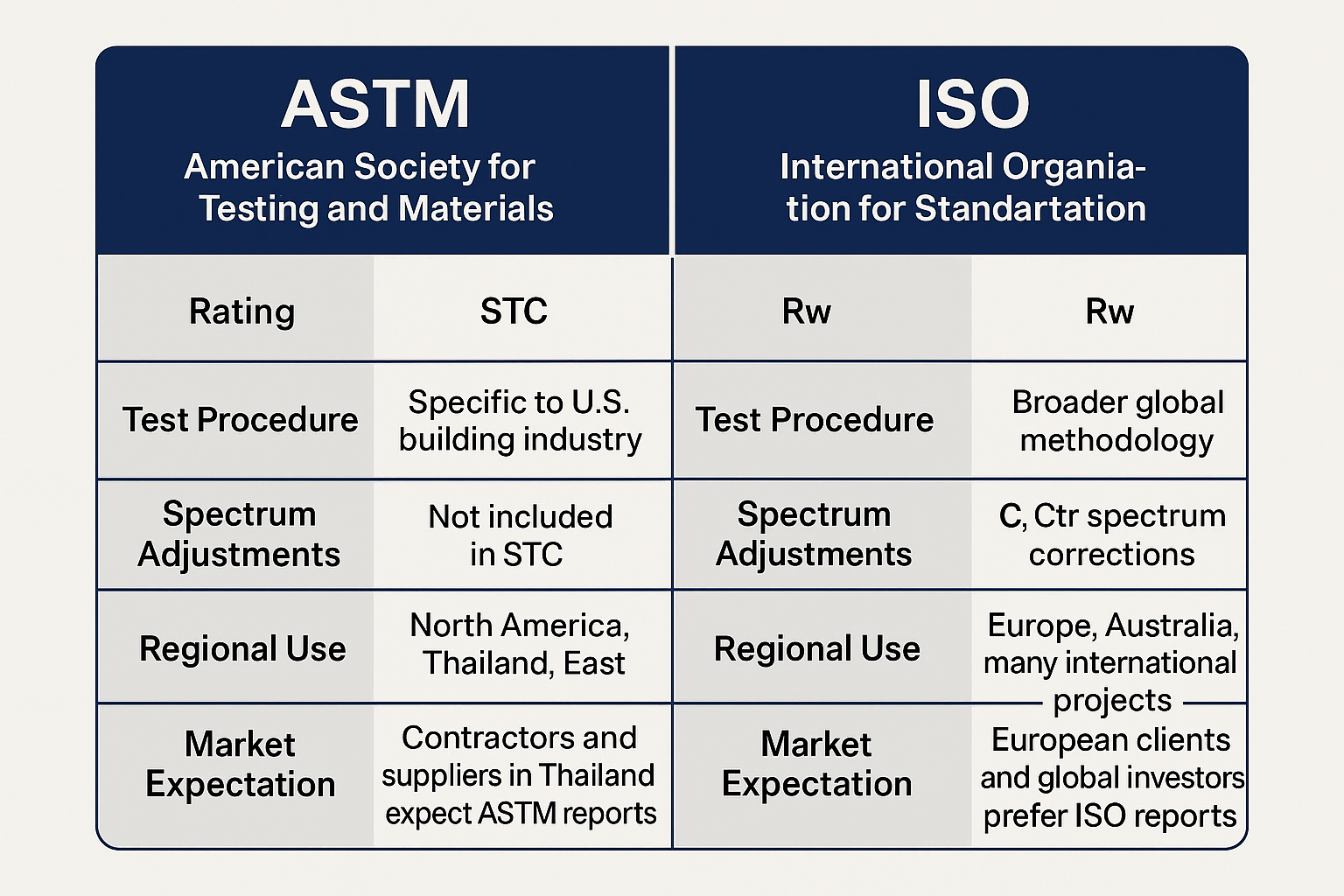
Key differences include spectrum adjustments (included in ISO, not ASTM), regional usage (ASTM in North America and Thailand vs ISO in Europe), and reporting expectations.

Why Thailand Adheres to ASTM
Thailand’s preference for ASTM is rooted in:
- Historic U.S. trade and construction influence
- Familiarity among local engineers and contractors
- Regulatory alignment with ASTM standards
- Consistency across Southeast Asian projects
Will Thailand Switch to ISO?
With globalization, more European investment, and regional integration, a shift toward ISO is possible. However, for now, ASTM remains the regulatory anchor. A practical solution may be dual reporting, where both ASTM (STC) and ISO (Rw) values are provided for international projects.
Conclusion
Currently, Thailand continues to follow ASTM standards for transmission loss. However, with international cooperation increasing, we may see more ISO-based projects in the future. At Acoustic Laboratory Thailand, we provide both ASTM- and ISO-compliant testing, ensuring that our clients meet local codes while preparing for global requirements.
Contact us today to learn more about acoustic testing services in Thailand.